Registered With PPTA (S10043)
Agility Training Physiotherapy
- Drrizwanphysio
- Sports Physiotherapy
- Agility Training Physiotherapy

Agility Training Physiotherapy in Karachi | Change-of-Direction (COD) Rehab & Return to Sport
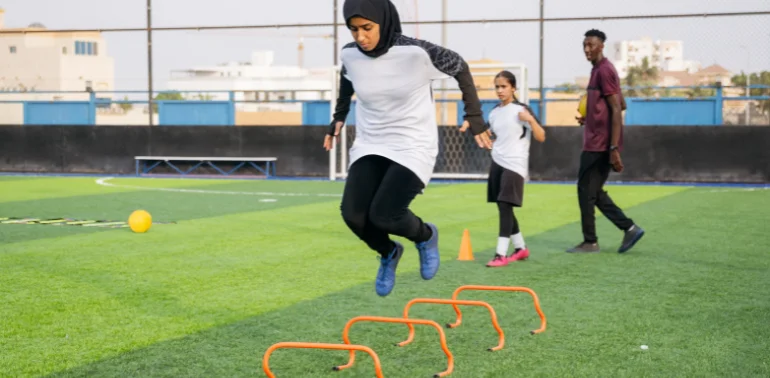
Agility training is the ability to quickly change direction, accelerate, decelerate, and react with control. In sports like football, cricket, basketball, badminton, and running-based games, agility is essential for performance—and it is also a common point where athletes re-injure themselves if they return too early. Agility training is usually introduced in the later stages of rehabilitation when basic mobility and strength are restored and the athlete needs sport-specific readiness.
At Dr Rizwan Physiotherapy Home Service, we provide structured agility training physiotherapy in Karachi with a step-by-step plan that improves change-of-direction (COD) mechanics, single-leg control, shock absorption, and reaction readiness to support a safer return to sport.
Why Agility Training Matters in Sports Rehabilitation
Agility is not only speed—it includes control and joint stability under rapid load. Many sports injury prevention and rehab approaches use neuromuscular training (balance + agility + dynamic stabilization + plyometrics) to improve movement efficiency and reduce injury risk. ([pmc.ncbi.nlm.nih.gov](https://pmc.ncbi.nlm.nih.gov/articles/PMC11236273/?utm_source=chatgpt.com))
- Improve acceleration and deceleration control
- Improve cutting and direction-change mechanics (COD)
- Improve single-leg stability and shock absorption
- Improve balance, coordination, and neuromuscular control
- Improve sport readiness after injury or surgery
- Reduce re-injury risk by fixing movement faults under speed
Who Needs Agility Training Physiotherapy?
- Athletes returning after ankle sprain or recurrent ankle instability
- Knee injuries (including post-op progression as per surgeon protocol)
- Hamstring, quadriceps, calf, or groin strain athletes returning to cutting sports
- Patellar/Achilles tendon pain athletes progressing back to speed and jumping demands
- Runners and field sport players with repeated overload due to poor mechanics
Our Agility Training Physiotherapy Program
We follow a criteria-based progression: restore mobility → build strength/endurance → develop balance/control → progress to planned agility → progress to reactive agility (game-like decision making). In sport rehab literature, athletes may progress from pre-planned COD drills to more reactive agility tasks as performance improves. ([pmc.ncbi.nlm.nih.gov](https://pmc.ncbi.nlm.nih.gov/articles/PMC12598428/?utm_source=chatgpt.com))
- Readiness assessment: pain, swelling, ROM, strength symmetry, single-leg control
- Deceleration training: stop mechanics, trunk control, knee/hip alignment
- Planned COD drills: cones, shuffles, 45°/90° cutting progressions
- Single-leg control: landing stability, lateral control, hip/knee alignment
- Agility ladder / footwork: speed with posture + control (as appropriate)
- Reactive agility: response-based drills (coach cues/visual cues) when ready
- Sport-specific integration: position or sport drills (football/cricket/badminton etc.)
- Load management: volume, intensity, rest days, recovery planning
- Home program with progression rules and safety guidance
Agility + Injury Prevention (Neuromuscular Training)
Neuromuscular training programs that include agility, balance and dynamic stabilization have evidence for injury-risk reduction, particularly in knee injury prevention contexts. ([pmc.ncbi.nlm.nih.gov](https://pmc.ncbi.nlm.nih.gov/articles/PMC11236273/?utm_source=chatgpt.com))
Our agility rehab plan focuses on improving movement quality first—then adding speed—so the joints and tissues can tolerate sport demands.
- Agility Training Physiotherapy in Karachi
- Change-of-Direction (COD) + Deceleration Mechanics Rehab
- Balance + Single-Leg Control + Neuromuscular Training
- Reactive Agility Progression for Return to Sport
Why Choose Dr Rizwan Physiotherapy Home Service?
- Criteria-Based Progression: Progress when movement quality + readiness are achieved.
- Technique First: Alignment, control and deceleration mechanics before speed.
- Sports Rehab Mindset: Rehab → reconditioning → sport readiness.
- Prevention Approach: Fix load and mechanics to reduce recurrence risk.
We provide physiotherapy services across Karachi, including DHA, Clifton, Gulshan-e-Iqbal, Gulistan-e-Johar, North Nazimabad, PECHS, and nearby areas.
What to Expect in Agility Training Sessions
Sessions include movement screening (single-leg squat, landing control, balance, cutting mechanics), then a step-by-step agility plan. You will learn safe deceleration, cutting technique, and progress toward sport-specific speed and reactive drills with measurable milestones.
Session structure and duration depend on the athlete’s condition and performance needs.
Book Agility Training Physiotherapy in Karachi
If you are looking for agility training physiotherapy in Karachi to improve change-of-direction control, reduce re-injury risk, and return to sport safely, Dr Rizwan Physiotherapy Home Service provides a structured program designed for sport demands.
Contact us today to schedule a physiotherapy session.
Frequently Asked Questions (FAQs)
How do I book an appointment?
Booking an appointment is simple! You can contact us through:WhatsApp: 0347-2018835 Call: 0347-2018835
What is agility training in physiotherapy?
Agility training in rehab focuses on safe acceleration, deceleration and direction changes with good control to prepare for sport demands.
What’s the difference between planned and reactive agility?
Planned agility is pre-decided cutting drills; reactive agility adds decision-making (responding to cues), closer to real sport situations.
Can agility/neuromuscular training reduce injury risk?
Yes—neuromuscular training that includes agility, balance and dynamic stabilization has evidence for injury-risk reduction in sport contexts.
What is included in an agility rehab plan?
Readiness screening, deceleration mechanics, planned COD drills, single-leg control, progressive speed/agility work, reactive drills, and sport-specific progression with load management.
When should athletes start agility drills after injury?
Usually after pain/swelling are controlled and basic ROM, strength and single-leg control are adequate—then agility is progressed step-by-step.


Qualified Doctors of Physical Therapy (DPTs)
Our DPTs hold advanced degrees in physical therapy, ensuring the highest level of care based on the latest scientific research and techniques. They offer:
- In-depth assessments and diagnosis
- Evidence-based treatment plans
- Hands-on manual therapy techniques
- Personalized rehabilitation programs
Whether you need pain management, post-operative care, or chronic condition support, our DPTs are here to guide you every step of the way.
- GET APPOINTMENT TODAY
Start Up Your Health Care With Us
Experience Staff
Certified therapists with advanced techniques. Book your session via WhatsApp now!
Personalized Treatment
Contact us on WhatsApp for a personalized treatment plan tailored just for you!